
Blog
How to Sign "Deaf" in ASL
Want to learn how to sign "deaf" in ASL? Follow step-by-step instructions, see accepted variations, avoid common mistakes, and understand Deaf culture.

Nicole Brener


Learning to sign the word "deaf" in American Sign Language is one of the most meaningful first signs you can pick up. It is a foundational word in the language, it comes up constantly in everyday conversation, and it carries real cultural weight in the Deaf community.
Whether you are starting an ASL class, preparing to meet a Deaf friend or coworker, or simply expanding your vocabulary, knowing how to sign this word correctly and respectfully is a great place to begin.
Learn exactly how to form the sign, the two accepted variations, the handshape and movement details, common mistakes to avoid, related vocabulary, and the cultural context that makes this particular word so important.
The Quick Answer
To sign "deaf" in ASL, extend your index finger into a "1" handshape, touch it near your ear, then move it down to touch near the corner of your mouth or your chin. The sign connects two points on your face: the ear, which represents hearing, and the area near the mouth, which represents speech. Together, they communicate the concept clearly and economically.
That is the short version. The rest of this article breaks down each part so you can sign it confidently and naturally.
Step-by-Step: How to Sign "Deaf"
Take it one piece at a time. Once you have practiced the steps a few times, the whole sign will take less than a second to produce.
Step 1: Form the handshape. Make a "1" handshape with your dominant hand. To do this, close your hand into a loose fist and extend only your index finger straight up. Your thumb rests against the side of your folded fingers. This is the same handshape used for pointing, and it is one of the most common handshapes in ASL.
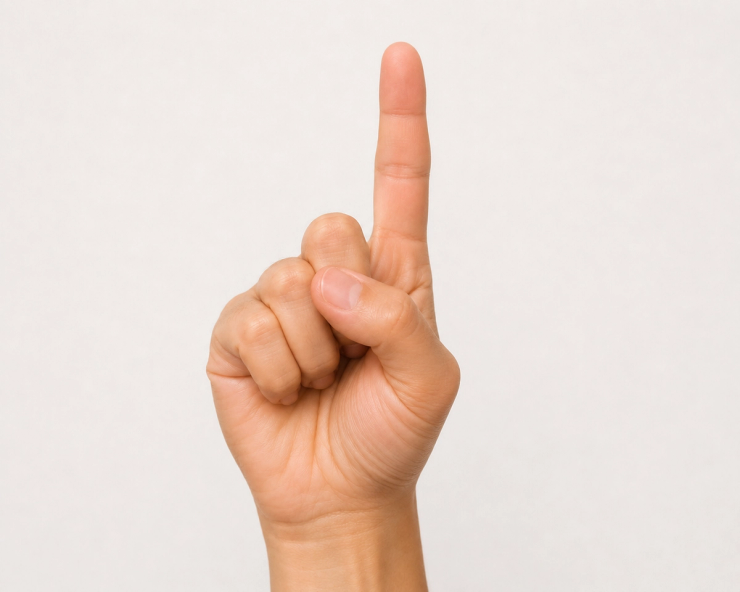
Step 2: Find the first contact point. Bring your extended index finger up toward your face and lightly touch the area just beside or slightly in front of your ear. You are not poking inside your ear. You are simply making contact with the cheek area near the ear to indicate the concept of hearing.

Step 3: Move to the second contact point. In a single smooth motion, move your index finger down and forward until it touches near the corner of your mouth or the lower cheek close to your chin. The path is short and direct.

Step 4: Keep it relaxed. The sign should feel light and effortless. Your hand stays relaxed, the movement is small, and there is no need to press hard at either contact point. A gentle touch at each spot is all that is required.
That is the complete sign. Ear, then mouth area, with a clean connecting movement between the two.
The Two Accepted Variations
One thing that often confuses new signers is that they see the sign for "deaf" produced in two different directions. Both are correct, and both are widely used by Deaf signers.
Ear-to-chin (ear first): You touch near the ear, then move down to the mouth or chin area. This is often taught as the standard or citation form of the sign, the version you are most likely to find in a dictionary or a beginner class.
Chin-to-ear (mouth first): You touch near the corner of the mouth first, then move up to the ear. This version is just as valid and is used naturally by many fluent signers.
Why does the direction change?
In everyday signing, the direction is often influenced by the signs that come before and after it.
Fluent signers unconsciously choose whichever direction flows more smoothly within a sentence. This is a normal feature of ASL, similar to how spoken languages blend sounds together for ease.
As a beginner, you can simply learn the ear-to-chin version first, and you will be perfectly understood. As you gain fluency, the other direction will start to feel natural in certain contexts.
The key point: do not stress about the direction. Both are recognized, and choosing one over the other will not cause confusion.
A Closer Look at the Handshape
The "1" handshape is the heart of this sign, so it is worth getting right. A few details help:
Your index finger should be straight but not rigid. A stiff, tense finger looks unnatural.
Aim for a comfortable, extended position. Your remaining three fingers stay curled down into your palm, and your thumb rests against them rather than sticking out. Sticking the thumb out turns it into a different handshape and can make the sign look unclear.
Some signers and some regional variations use a handshape closer to a "D" hand, but the standard and most widely taught form uses the simple index finger point. If you are learning for the first time, the "1" handshape is the safest and clearest choice.
Facial Expression and Non-Manual Signals
In ASL, facial expressions and head movements carry grammatical meaning. They are not optional decoration.
For the word "deaf" on its own, you do not need a dramatic expression. A natural, neutral face is appropriate when you are simply stating the word.
However, the expression changes with context. If you are asking a question, such as "Are you deaf?", your eyebrows would raise and your head might tilt slightly forward, because that is how yes-or-no questions are marked in ASL.
If you are stating "I am deaf" as a simple fact, your face stays relaxed and matter-of-fact.
Matching your expression to the meaning of your sentence is part of signing fluently, and it is a habit worth building from your very first signs.
Common Mistakes to Avoid
New signers tend to make a handful of predictable errors with this sign. Watching for them will speed up your progress.
Poking your actual ear. The sign touches the cheek area near the ear, not the ear canal. Keep the contact on the face, light and natural.
Using the wrong handshape. A closed fist, a flat hand, or a hand with the thumb sticking out all change the appearance of the sign. Stick with a clean "1" handshape.
Making the movement too large. The path between the two contact points is short. A big, sweeping arm motion looks exaggerated and unnatural. Keep the movement compact and controlled.
Confusing it with the sign for "hearing." This is the most common mix-up, and the next section explains the difference in detail.
Over-pressing the contact points. You only need to touch lightly. Jabbing your face is unnecessary and looks tense.
Forgetting the connecting movement. The sign is not just two separate taps. It is one fluid motion that links the ear to the mouth area. The movement between the points is part of the meaning.
Related Signs Worth Learning
Once you can sign "deaf," a few closely related signs will round out your vocabulary and help you avoid confusion.
Hearing (a hearing person): This is the sign most often confused with "deaf." To sign "hearing," use a "1" handshape and make small forward circular movements in front of your lips or chin. The motion suggests words rolling out of the mouth. Notice that it stays near the mouth and does not touch the ear, which is the main visual difference from "deaf."
Hard of hearing: This sign uses an "H" handshape, made by extending your index and middle fingers together. You produce a small movement, often a little hop or shift to the side, repeating the "H" shape twice. It describes someone with partial hearing loss.
Hear: To sign the verb "hear," simply point to or touch your ear with your index finger.
Deaf school, Deaf community, Deaf culture: These are compound expressions that combine the sign for "deaf" with another sign. Learning the base sign well means you can build these naturally later.
Practicing "deaf" and "hearing" side by side is especially useful, because clearly distinguishing them is a sign of a careful, respectful signer.
Learning ASL
Learning a single sign is a wonderful start, but ASL is a full language and a doorway into a vibrant community. A few principles will help you learn in a way that honors that.
Learn from Deaf people whenever possible. Deaf instructors, Deaf content creators, and Deaf-led classes provide authentic models of the language and its culture. ASL is best learned visually and in community, not from a list of static pictures.
Practice consistently rather than cramming. A few minutes every day will build fluency faster than an occasional long session.
Be patient with yourself. Like any language, ASL takes time. Your early signs will feel awkward, and that is completely normal.
Stay humble and open to correction. If a Deaf person gently corrects how you sign something, that is a gift, not criticism. It means they are investing in your learning.
Practice Tips for the "Deaf" Sign
To lock in the sign, try these simple exercises:
Practice in front of a mirror so you can see what your sign looks like from the receiver's perspective.
Record yourself on video and compare it to clips of Deaf signers online.
Practice both directions, ear-to-chin and chin-to-ear, so each one feels comfortable.
Drill "deaf" and "hearing" back to back until the difference is automatic.
Finally, use the sign in real sentences, such as "I am learning ASL because my friend is deaf," so the word lives in context rather than in isolation.
When You Do Not Share a Common Language Yet
While you are still building your ASL skills, you may find yourself wanting to communicate with a deaf person before you are fluent. That is completely fine, and there are tools that bridge the gap.
Writing back and forth, texting, and gesturing all work in person. For phone conversations, captioning apps such as Nagish let a deaf person and a hearing person talk by converting speech to text and text to speech in real time. Tools like these do not replace learning ASL, but they keep communication open and respectful while your signing vocabulary grows.
The Bottom Line
Signing "deaf" in ASL is simple to learn and rich in meaning. Form a "1" handshape, touch near your ear, and move to the corner of your mouth or chin in one smooth motion. Either direction, ear-to-chin or chin-to-ear, is correct. Keep the handshape clean, the movement small, and your facial expression matched to your meaning.
Most importantly, remember that this sign represents a real community with its own language, culture, and pride. Learning it well, and continuing to learn beyond it, is a genuine sign of respect. From this one word, an entire language and community open up. It is a small motion of the hand with a very large welcome behind it.
How to Sign "Deaf" in ASL - FAQs
Is it offensive to ask someone if they are deaf?
Not at all, as long as it is asked respectfully and in an appropriate context. Deafness is not something to whisper about or avoid mentioning. Many Deaf people are proud of their identity and will appreciate genuine curiosity over awkward avoidance.
Should I capitalize "Deaf" or use lowercase "deaf"?
Both are correct, but they mean slightly different things. Lowercase "deaf" usually refers to the audiological condition of not hearing. Capitalized "Deaf" refers to the cultural and linguistic community of Deaf people who use ASL and share a shared identity. When in doubt, follow the lead of the person or community you are referring to.
Is the sign for "deaf" the same in every country?
No. ASL is used primarily in the United States and parts of Canada. Other countries have their own sign languages, such as BSL (British Sign Language), LSF (French Sign Language), and LSM (Mexican Sign Language), each with their own sign for "deaf." Sign languages are not universal.
Can I learn ASL just from videos and apps?
You can build a solid foundation that way, but ASL is best learned through interaction with Deaf signers. Videos and apps are great starting points, but real conversations, Deaf-led classes, and immersion in the community will accelerate your fluency far more than self-study alone.
How long does it take to become fluent in ASL?
Like any language, fluency takes years of consistent practice. Most learners can hold basic conversations within six months to a year of regular study, but true fluency typically requires several years of immersion and practice with Deaf signers.
What is the difference between ASL and signed English?
ASL is a complete, independent language with its own grammar, syntax, and structure, distinct from English. Signed Exact English (SEE) and other manually coded English systems use signs to represent English word-for-word. ASL is the natural language of the Deaf community in the U.S.
Do I need to know how to fingerspell to learn the sign for "deaf"?
No, the sign for "deaf" does not require fingerspelling. However, learning the ASL alphabet early on is highly useful because fingerspelling is used constantly for names, places, and words that do not have a dedicated sign.
Is it rude to use voice while signing?
It depends on the context. In Deaf spaces and Deaf-led conversations, voicing while signing can be considered disrespectful because it shifts attention away from ASL. In mixed hearing-Deaf settings, voicing is sometimes appropriate. When in doubt, follow the lead of the Deaf people present.
What should I do if I forget a sign mid-conversation?
Fingerspell the word, gesture, or write it down. Deaf people are usually patient with learners and appreciate the effort. Asking "How do you sign ___?" is a perfectly acceptable and respectful way to learn in the moment.
Nicole Brener Copywriter based in Miami, FL. Leads copywriting workshops and mentors women entrepreneurs at the Idea Center of Miami Dade College.
Read next

How to Call a Deaf Person on the Phone: The Complete 2026 Guide
Need to call a deaf person on the phone? Learn how 711 relay services, VRS, captioned phones, and apps like Nagish make communication simple in 2026.
June 12, 2026

How to Know If You're Going Deaf in One Ear: Common Signs, Causes, and What to Do Next
Wondering if you're going deaf in one ear? Learn the early signs of single-sided hearing loss, common causes, when it's an emergency, and what to do next.
June 11, 2026

Nagish is Now Rylo
We’re introducing the first of its kind communication engine for Deaf and hard-of-hearing people, with a new name, a new app, and $85M to build what comes next.
June 9, 2026