
Blog
What Causes Dinner Table Syndrome and How Can Technology Help?
Wondering what causes Dinner Table Syndrome? Learn why Deaf and hard-of-hearing people are often left out of conversations and how technology can help.

Colton Jannusch


Dinner Table Syndrome is a social phenomenon describing the profound isolation Deaf and hard-of-hearing individuals experience when surrounded by hearing family and friends.
Despite being physically present at meals or gatherings, they are continuously excluded from group conversations, not out of cruelty, but due to communication habits and environmental barriers that most hearing people never notice.
Understanding what causes Dinner Table Syndrome is the first step toward fixing it, and today, tools like Rylo are making that easier than ever.
This phenomenon affects adults and children alike, including the many Deaf individuals who have hearing parents who do not sign. In fact, 90% of Deaf children are born to hearing parents, and 88% of those parents never learn a signed language to communicate with their child.
Dinner Table Syndrome is particularly common during festive meals, holidays, and group celebrations where conversation moves the fastest and the stakes of belonging feel the highest.
What Causes Dinner Table Syndrome?
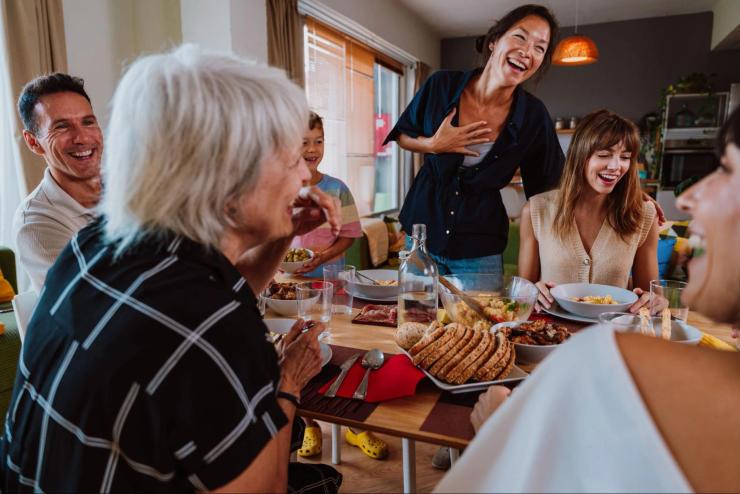
Dinner Table Syndrome doesn't have a single cause. It's the result of several overlapping communication dynamics that hearing people rarely think about.
At the most basic level, the pace of hearing conversation is simply incompatible with what Deaf and hard-of-hearing individuals need to follow along.
Hearing people speak quickly, interrupt each other, and rely on auditory cues to track who is speaking next. Layered on top of that, topics shift rapidly and conversations often happen simultaneously across the table, making it nearly impossible to lip-read or keep up in any meaningful way.
When a Deaf individual does try to re-enter the conversation by asking what was just said, the response they most often receive is a dismissal: "Oh, it was nothing" or "I'll tell you later." Except later rarely comes.
These small moments of exclusion accumulate over time, quietly communicating that what they missed wasn't worth the effort of sharing.
The physical environment adds another layer of difficulty. Poor lighting makes facial expressions and lip movements harder to read. Rectangular seating arrangements mean some people are entirely out of sightline. These are details hearing people never have to consider, but for a Deaf or hard-of-hearing person, they determine whether participation is even possible.
Underlying all of it is a deeper structural gap: with 88% of hearing parents never learning to sign, most Deaf children grow up in households where no shared visual language exists. That means every group conversation, every holiday dinner, every family gathering, starts from a position of inaccessibility before anyone has said a word.
The Emotional Toll of Being Left Out

Being surrounded by people talking without the ability to follow the conversation takes a real toll. It's not just the information that gets lost… it's the sense of belonging.
The painful accumulation of being left out at the family table over a lifetime causes many Deaf and hard-of-hearing people to dread going home for the holidays. Although exclusion is rarely intentional, Deaf and hard-of-hearing individuals are left feeling stressed, lonely, angry, and unimportant.
Beyond the immediate emotional impact, there is something deeper at stake: informal and incidental learning.
Hearing children absorb enormous amounts of knowledge simply by being present at the table absorbing context, stories, values, and family history as conversation flows naturally around them. Deaf children in non-signing households are cut off from this entirely.
By contrast, Deaf children raised in homes where sign language is used freely and conversations are genuinely accessible perform better academically, develop stronger cognitive and spatial reasoning skills, report less depression as teenagers, and go on to live more successful, independent lives.
How the Community Copes
Experiences and frustrations vary widely, but discussions within the Deaf community reveal some common patterns in how people navigate these situations.
The most common response is disengagement. Many individuals simply zone out, silently stifling their frustration before asking to be excused early. Some take their plate of food to another room and eat alone. Others read books, draw pictures, or scroll through their phone at the table, finding ways to occupy themselves rather than endure the exhaustion of trying to follow a conversation they can't access.
When full participation isn't possible, many people scale back their expectations entirely and focus on connecting with just one person, typically whoever is seated directly next to them and making a visible effort to communicate. It becomes less about being part of the group and more about finding one safe point of connection in the room.
Some Deaf individuals, particularly those who are older or have had more experience advocating for themselves, take a more assertive approach. They name their communication needs directly, redirect the group, or establish expectations before the gathering even begins. But this kind of self-advocacy requires confidence that not everyone has, and it shouldn't fall solely on the Deaf person to fix a problem they didn't create.
These coping strategies are understandable, but they shouldn't be necessary. The right tools and awareness can change the dynamic entirely.
How Can Technology Help?
This is where technology changes the equation. Rylo is a free app built to help Deaf and hard-of-hearing individuals stay connected in real-world, everyday situations. Not just structured settings, but the messy, spontaneous, fast-moving moments where Dinner Table Syndrome most often strikes.
Whether it's a loud family dinner, a casual birthday party, a work team lunch, or a graduation reception, rylo gives users the tools to follow conversations independently and confidently without having to constantly ask others to repeat themselves.
For this kind of scenario, Rylo Live Transcribe is the most popular choice. Live Transcribe is a feature in the Rylo Phone app that converts speech into text on your screen in real time. It provides live captions for in-person conversations, meetings, lectures, announcements, and everyday interactions, helping people who are deaf or hard of hearing stay connected and engaged.
It displays spoken dialogue as real-time text directly on a user's phone screen, making it possible to follow along as conversations happen — even in fast-paced or noisy environments. Its intuitive, mobile-friendly design means it feels natural rather than intrusive — something you can rely on in the moments that matter most.
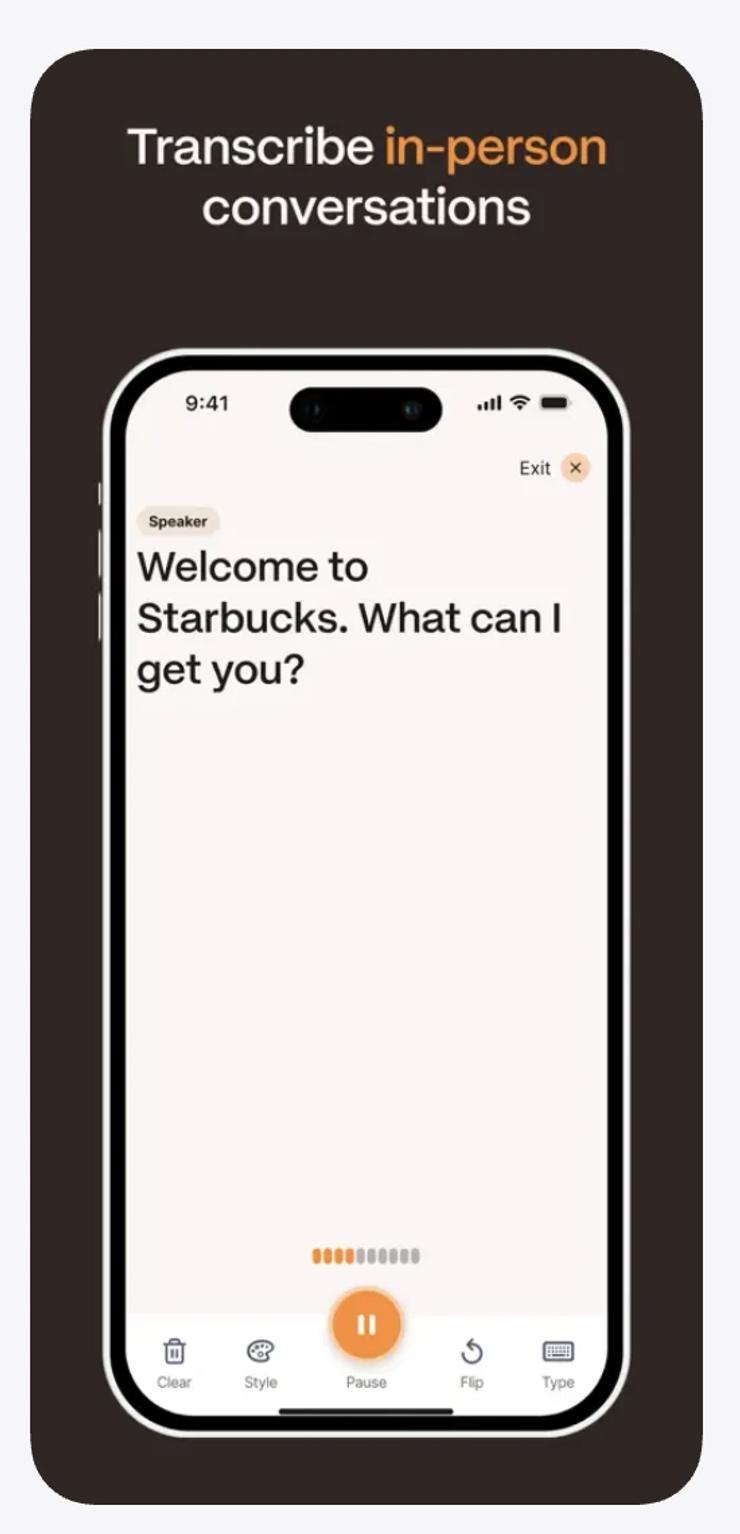
Screenshot of the Rylo app displaying a Live Transcribe session, showing the text "Welcome to Starbucks. What can I get you?" transcribed in real time during an in-person conversation.
How to Use Rylo in Social Settings
Dinner Table Syndrome doesn't only happen at dinner. It shows up at birthday parties, graduation receptions, team lunches, holiday gatherings, and casual meetups at noisy restaurants. Any setting where multiple people are talking at once, where the room is loud, or where conversations move quickly is a setting where a Deaf or hard-of-hearing person can find themselves on the outside looking in.
This is where tools like Rylo Live Transcribe can make a genuine difference. Rather than relying on someone else to interpret or repeatedly asking people to repeat themselves, a user can follow spoken conversation as real-time text on their phone. It doesn't solve every challenge, but in the moments where simply keeping up is the barrier, having that access changes the experience of being in the room entirely.
Rylo Live Transcribe is free and ad-free, and because it works offline, it doesn't depend on having a strong connection in the middle of a crowded venue or a basement family gathering.
It also saves transcripts, so if something important was said during a toast or a conversation you wanted to remember, you can go back and read it later. To use it, you simply hold your phone up or set it on the table and the speech around you becomes text in real time.
Steps for a More Inclusive Gathering
Technology addresses the gap in the moment, but preventing Dinner Table Syndrome also requires intentional habits from the hearing people at the table.
Some of the most effective changes are purely logistical. Arranging seating in a circle rather than around a rectangular table lets everyone see each other's faces and hands. Good lighting matters more than most people realize, as it makes speechreading and reading facial expressions significantly easier. Turning down background music or the television during meals removes one more layer of interference that hearing people tune out but Deaf and hard-of-hearing individuals cannot.
How people communicate at the table matters just as much as the setup. Getting someone's attention before speaking to them, with a gentle wave in their line of sight or a tap on the shoulder, gives them a fair chance to follow along. Encouraging one person to speak at a time rather than talking over each other makes conversation more manageable for everyone, not just those with hearing loss.
In the flow of conversation itself, the small choices carry real weight. Sharing the context of a joke or story as it happens rather than promising to explain it later means the person gets to be part of the moment, not a delayed summary of it. And learning even a few signs, basic fingerspelling or a handful of common phrases, goes a long way. ASL works alongside any spoken language and signals clearly that someone belongs at the table.
Finally, pay attention to the phrases that get used when someone asks what they missed. Responses like "never mind," "it was nothing," or "you didn't miss much" may feel like small talk, but over time they send a clear message about whose presence at the table is actually valued.
Making Every Gathering More Inclusive
Dinner Table Syndrome isn't limited to holidays or special occasions. It shows up wherever people gather to share time, conversation, and connection, and its effects extend far beyond any single meal.
The Deaf or hard-of-hearing individual sitting quietly at the end of the table isn't just missing a conversation. They're missing the informal, incidental moments of learning and belonging that form the foundation of family life.
Understanding the causes is only the first step. The habits and adjustments covered in this article can make a real difference, and for moments when the conversation moves too fast or the room is too loud, having rylo on hand means nobody has to tap someone's arm and ask what was just said. It's a simple, free tool that a Deaf or hard-of-hearing person can open on their phone and place on the table alongside their dinner plate, no setup required, no disruption to the gathering. The conversation keeps moving and they stay part of it.
With the right awareness and the right support, nobody has to feel left out of the moments that matter most.
Colton Jannusch A passionate and dedicated English teacher who creates an inclusive and engaging learning environment, inspiring students to develop their language skills and cultivate a lifelong love for literature.
Read next

How to Call a Deaf Person on the Phone: The Complete 2026 Guide
Need to call a deaf person on the phone? Learn how 711 relay services, VRS, captioned phones, and apps like Nagish make communication simple in 2026.
June 12, 2026

How to Know If You're Going Deaf in One Ear: Common Signs, Causes, and What to Do Next
Wondering if you're going deaf in one ear? Learn the early signs of single-sided hearing loss, common causes, when it's an emergency, and what to do next.
June 11, 2026

How to Sign "Deaf" in ASL
Want to learn how to sign "deaf" in ASL? Follow step-by-step instructions, see accepted variations, avoid common mistakes, and understand Deaf culture.
June 11, 2026